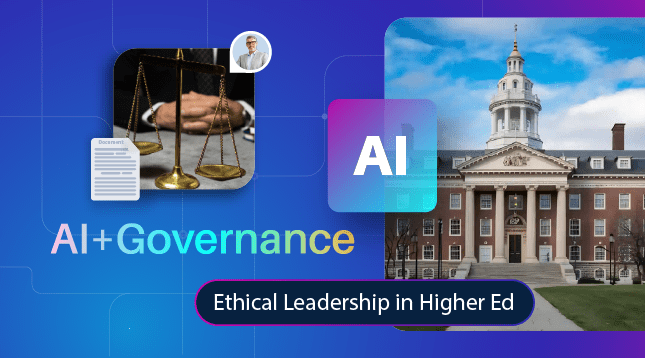
Ethical Imperatives of AI: Navigating Ethical Practice and Societal Impact

Classify ethical risks, protect student data privacy, and apply copyright standards in GenAI-enhanced teaching and research.

Best Seller

Online

What You'll Learn

Classify major ethical risks of GenAI including bias, deepfakes, and copyright based on UNESCO guidelines.
Determine appropriate institutional and faculty actions for protecting student data privacy and model transparency.
Apply intellectual property and copyright compliance standards to GenAI outputs in academic contexts.
Select strategies to counter cultural bias in GenAI tools for Middle Eastern educational contexts.
Implement interventions that encourage students to challenge GenAI outputs rather than accept them as truth.
Match GenAI use cases to corresponding UNESCO principles of human agency and pluralism.

Skills You Will Master In

Ethical Risk
Data Privacy
Intellectual Property
Critical Thinking
Policy Development

At a Glance

Who Should Enroll

Higher education faculty, instructional designers, academic leaders, and policy makers committed to leading with ethical principles in AI adoption within educational settings

Requirements

No prior experience with AI or programming is needed, but an eagerness to learn and explore new technologies is a plus!

Course Content

Module 1: Bias, Transparency, and Accountability
Locked

Examine sources of cultural bias in GenAI outputs, understand the “black box” problem, and differentiate between ethical concerns of deepfakes and algorithmic bias. 

Key Topics: 

  1. Selecting the most likely source of cultural bias in GenAI for Middle Eastern contexts. 
  2. Identifying the primary characteristic of GenAI systems that lack transparency (black box problem). 
  3. Recognizing Western-centric training data as a bias source. 
  4. Differentiating between deepfake generation and algorithmic bias as ethical concerns. 
  5. Matching scenarios to correct ethical risks: deepfakes versus bias. 
Module 2: Data Privacy and User Protection
Locked

Establish mandatory data protection measures before requiring student GenAI use, identify privacy violations, and select strategies to protect students from inappropriate outputs. 

Key Topics: 

  1. Determining mandatory data protection measures for third-party GenAI tools. 
  2. Identifying institutional privacy agreements required with GenAI vendors. 
  3. Recognizing scenarios that violate regional data privacy regulations (GCC laws). 
  4. Selecting ethical strategies to counter inappropriate or culturally insensitive outputs. 
  5. Identifying sandboxing and vetted EdTech GenAI as proactive protection strategies. 
Module 3: Intellectual Property and Copyright
Locked

Classify student-created GenAI content for intellectual property purposes, identify legal risks in proprietary materials, and determine correct citation formats for AI outputs. 

Key Topics: 

  1. Classifying GenAI-assisted student content as human-authored IP or non-human output. 
  2. Distinguishing between prompt refinement and copy-paste for citation purposes. 
  3. Identifying legal risks of copyright infringement in training data usage. 
  4. Determining correct citation formats (APA, MLA) for GenAI outputs. 
  5. Determining IP status of student tasks involving GenAI collaboration. 
Module 4: Promoting Pluralism and Critical Engagement
Locked

Analyze how GenAI homogenization impacts critical thinking, select effective faculty interventions, and match GenAI use cases to UNESCO principles being violated. 

Key Topics:

  1. Analyzing how homogenization of opinions by GenAI negatively impacts postgraduate research. 
  2. Selecting effective faculty interventions to encourage challenging GenAI outputs. 
  3. Analyzing consequences of reduced diversity in theoretical frameworks. 
  4. Implementing fact-checking and empirical testing requirements for students. 
  5. Matching student GenAI use scenarios to corresponding UNESCO principles (Human Agency, Pluralism). 
×

Upcoming Cohort Schedules

No training calendar entries found.

Course Sample Certificate

FAQ

How will this course help me handle ethical challenges with AI?
This course provides you with the knowledge to identify and manage key ethical concerns like bias, data privacy, and intellectual property, enabling you to responsibly integrate AI in your academic work.
Do I need any prior ethics or legal background to enroll?
No special background is required. The course introduces fundamental concepts clearly and directly, making it accessible whether you have prior experience or not.
How can I apply what I learn to my institution’s policies?
You will learn best practices and frameworks that can inform or enhance your institution’s AI guidelines, helping you lead ethical AI adoption in your academic community.

Enroll to alignLX’s Best Seller Course

$120.00 $160.00 25% off

Share this course